

Trade Deals, Finally Explained

Our aim through TVS Weekly is to break down financial stories and concepts simply, explaining what happened and why it matters to you.
No jargon, no drama, just stuff that actually makes sense!
Curious? Get more from us on our Instagram, WhatsApp, LinkedIn, or YouTube. Our 1 Million+ family awaits you!
In this week’s newsletter, we will be learning:
Why do understanding trade deals matter.
What are trade deals and India’s history in it.
Understanding what’s in a trade deal using the India-EU trade deal example.
Market Kya Keh Raha Hai Sir?
On 27 January, PM Modi, alongside European Commission President Ursula von der Leyen, announced what he called the ‘mother of all deals’.
The India-EU free trade agreement.
Every news channel covered this deal. Every business newspaper analysed the winners and losers.
As students of finance, you will encounter free trade deals regularly, and given their significance, it becomes important to understand how these work.
Last month, we learned how to read a stock, understanding equity research, annual reports, and earnings calls.
This month, let’s zoom out and understand the macro policy forces that move entire sectors.
Why Trade Deals Matter
No building makes sense unless you understand why it was built in the first place.
So, before we dive into definitions and mechanics, let’s understand why you should care about trade deals.
Because trade deals aren’t abstract policy documents. They show up in the financial statements you are learning to analyse.
When you analyse an Indian listed company’s annual report, you are required to look at certain disclosures.
AS 17 – Segment reporting is one of them.
These companies must disclose revenue from external customers by geographic segments when those segments represent 10% or more of total revenue.
Let’s take the example of TCS.
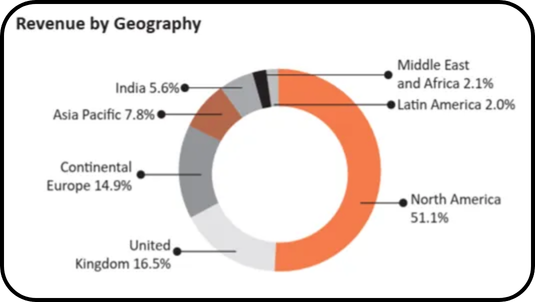
14.9% of TCS’s revenue comes from Europe, which is directly affected by the provisions made in the India-EU trade deal.
The deal can either open new market opportunities or add restrictions that can limit growth.
And to ascertain that, you need to understand the terms of the deals.
Similarly, the impact of the trade deals is also seen in the earnings calls of companies.
Ramkrishna Forgings incurred a loss of Rs. 9.5 crores in Q2 FY 26, and this is what the management had to say.

This was followed by the US imposed 50% tariffs on trade.
And while one company faces losses, it might be beneficial for a company in some other sector.

This was said by the management of CCL products amid the tariff situation.
Also, companies disclose risk factors in the notes to accounts section.
Where they talk about how trade policies and import duties can affect their costs and margins.
And the impact of these trade deals and tariffs is global, and they affect the trade practices of almost all economies.
In fact, in 2025, a record 255 S&P 500 companies mentioned tariffs in their earnings calls.
So, while you are learning to read financial statements, it is important to understand what the management means by tariffs and the impact of trade deals.
This newsletter teaches you that foundation.
Trade Deals 101
Let’s first start with the basic definition.
A Free Trade Agreement (FTA) is a treaty between countries to reduce or eliminate barriers that restrict trade across borders.
Break it down:
Free means removing costs that block trade.
Trade means the exchange of goods and services between countries.
An agreement means a legally binding treaty.
And together, it is about countries agreeing to reduce or eliminate barriers so businesses can trade more easily.
The primary barrier these agreements address is something which we have been hearing frequently since last year; tariff.
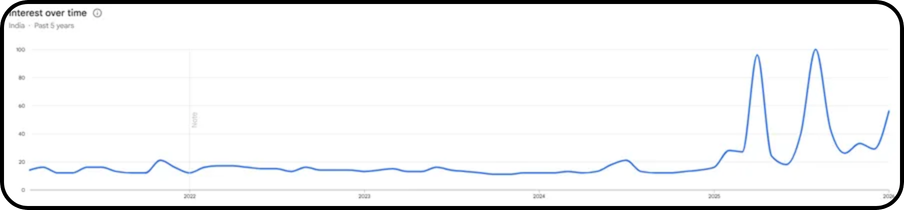
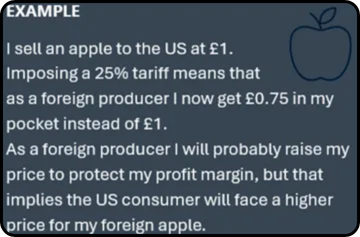
Tariffs are taxes imposed by a government on goods and services imported from other countries.
Think of a tariff like an extra cost added to foreign products when they enter the country. They are usually a percentage of the price of the goods.
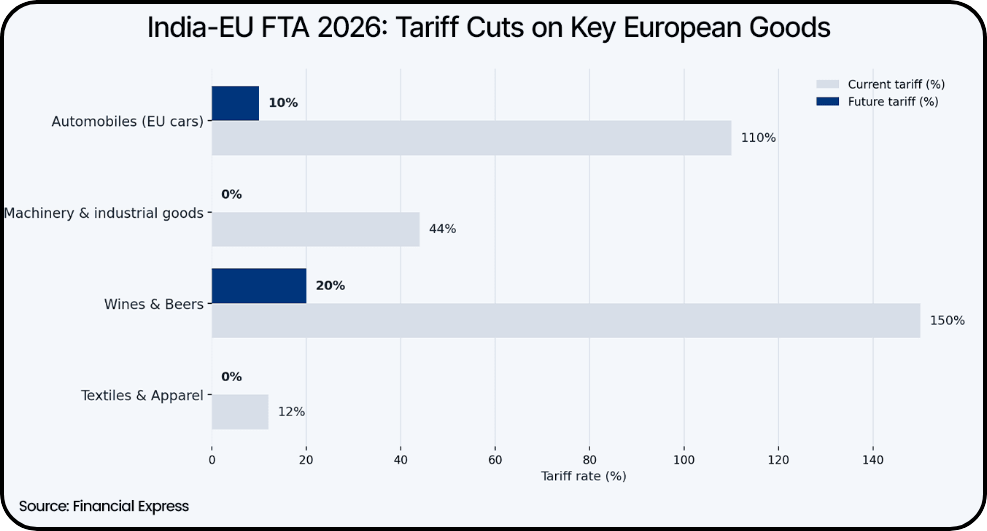
Currently, European passenger cars face a 110% tariff when entering India.
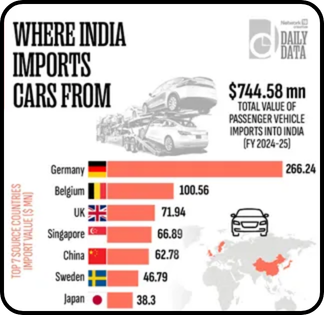
Suppose a Mercedes-Benz costs ₹1 crore in Germany.
When it arrives at an Indian port, Indian customs apply a 110% tariff. That’s ₹1.10 crore in tariff charges. The total cost in India becomes ₹2.10 crores.
But why does India charge this tariff?
First, to generate revenue for the government.
Second, to protect domestic industries. If European cars entered India without any tariffs, then domestic companies would face direct competition at lower rates.
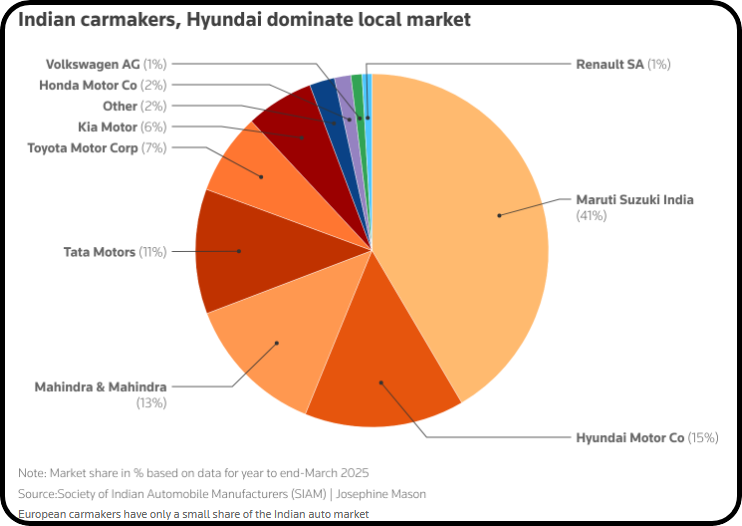
Third, to use it as a negotiation tool. India can offer to reduce tariffs in exchange for concessions like duty-free access for Indian textiles or pharmaceuticals in European markets.
And now, after the India-EU Free Trade Agreement was concluded, the tariff structures are about to change.
For instance, the 110% tariff imposed on European cars is set to be reduced in phases.
Initially, the rate will be cut to around 40% and will settle at 10% over time.
Now that you understand what trade deals are and how tariffs work, let’s talk about India’s journey with these agreements.
India’s history of trade deals
India’s journey with trade deals began in 1998.
That year, India signed its first bilateral FTA with Sri Lanka.
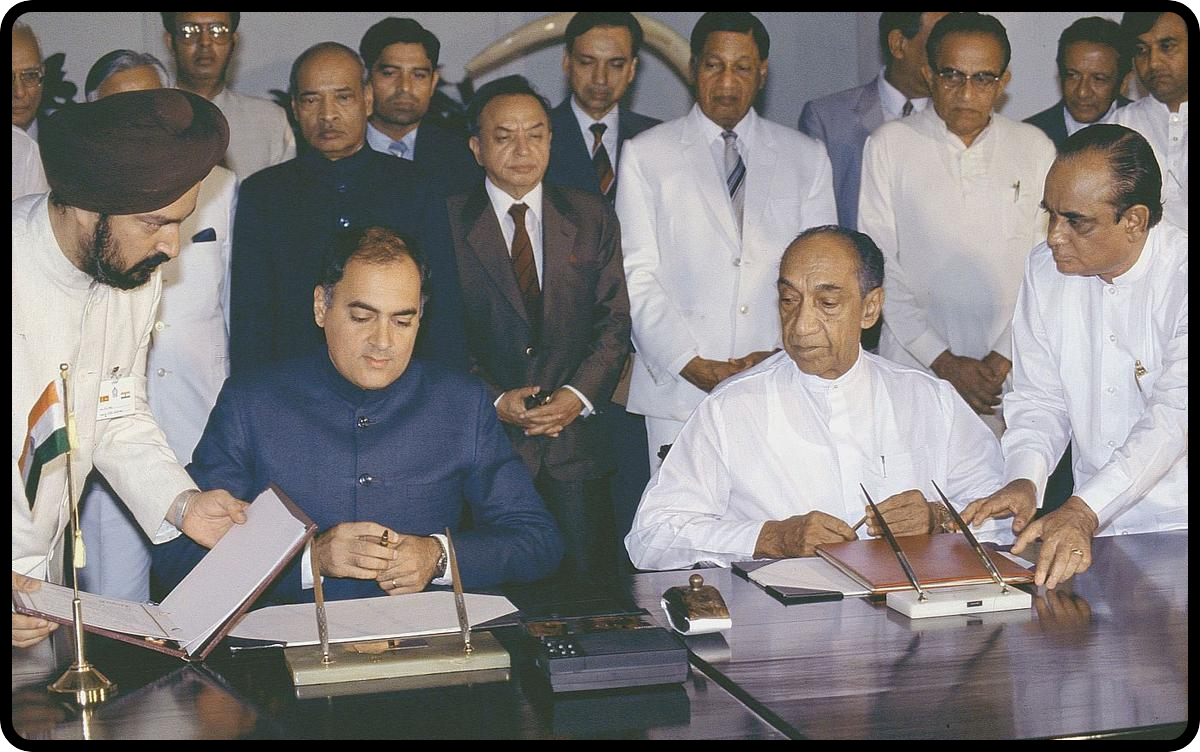
Later in 2005, it went on to sign an agreement with Singapore, which marked its first deal with a developed economy.
Between 2010 and 2011, India signed agreements with ASEAN (10 countries), South Korea, and Japan.
Last year itself, India signed deals withthe UK, Oman, and New Zealand.
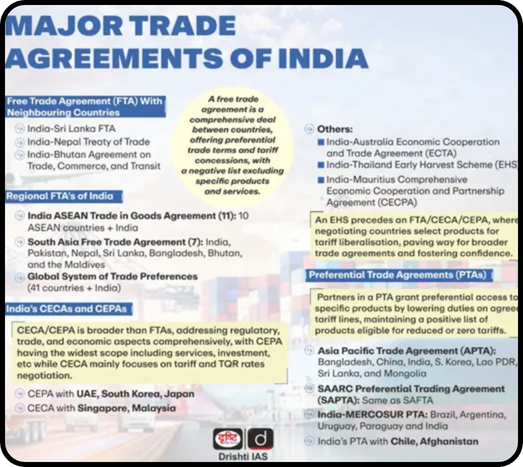
As of January 2026, India has 13 Free Trade Agreements, but these are not the only kind of deals, as trade deals come in different forms.
Preferential Trade Agreement (PTA)
This is the most basic type. Countries agree to reduce tariffs on a limited list of products, not everything, just select items.
India has PTAs with Chile and is part of a total of 6 of them
Free Trade Agreement (FTA)
FTAs generally cover around 90% or more of traded goods, meeting the WTO’s requirement of substantially all trade.
India-Sri Lanka was the first trade deal, with the India-EU deal being the latest.
Comprehensive Economic Partnership Agreement (CECA)
A CEPA goes beyond goods and even includes services traded, investment protections, etc.
Some notable examples are India-UAE CEPA (2022) and India-South Korea (2010).
While the India-EU trade deal is designated as an FTA, it also includes services and other economic provisions often seen in a CEPA.
That is the reason it is often labelled as a comprehensive FTA.
Now that we understand different deals and India’s history with them, let’s dissect the India-EU deal to see how all these concepts come together in practice.
The Mother of All Deals

What is being celebrated today actually took 20 years to make.
The negotiations for this deal started in 2007, collapsed completely in 2013, restarted in 2022, and finally concluded this week.
The India-EU deal covers approximately 25% of the world’s GDP and connects a market of nearly 2 billion people.
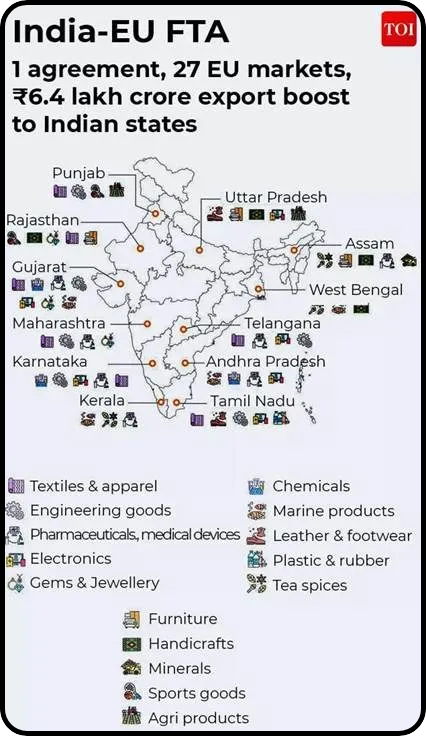
Almost all trade agreements share the common components
And today, we will use the India-EU Free Trade Agreement to understand what gets negotiated inside a trade deal.
Starting with one of the core components of any trade deal; Tariff Reductions.
This gives the detailed breakdown of which products get tariff reductions, by how much, and over what timeline.
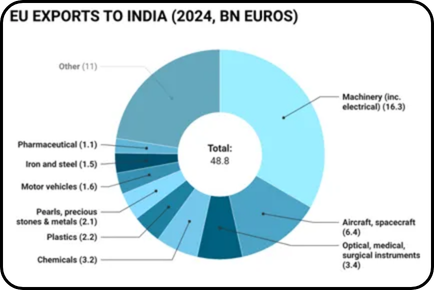
In this deal, the EU will remove tariffs on almost all imports from India, covering about 99% of trade by value.
India will also cut tariffs on most EU imports, covering about 97% of trade.
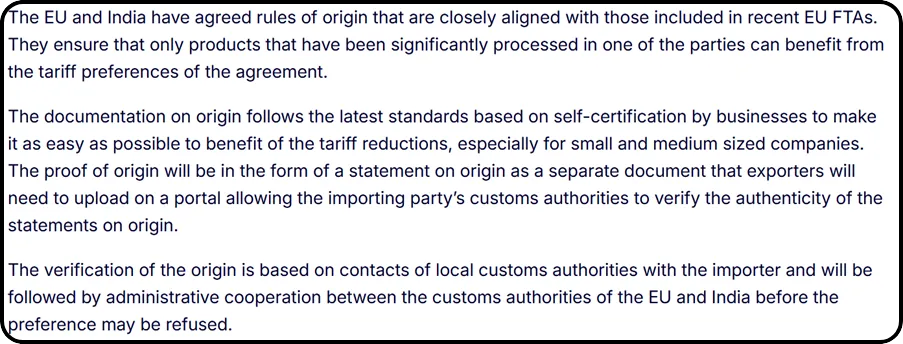
The next component is the Rules of Origin.
Rules of Origin define where a product is from. They prevent third-country goods from entering at lower tariffs by routing them through a partner country.
For example, China wants to export steel to the EU duty-free. But China is not part of the India-EU FTA. So could China ship steel to India, add a Made in India label, and then re-export it to the EU, claiming FTA benefits?
The answer is no, because of the Rules of Origin.
However, no free trade agreement covers 100% of products. Both sides protect politically sensitive sectors from foreign competition.
India has safeguarded sensitive sectors, including dairy, cereals, and certain fruits and vegetables.
At the same time, the EU will be protecting sugar, ethanol, bananas, and honey.
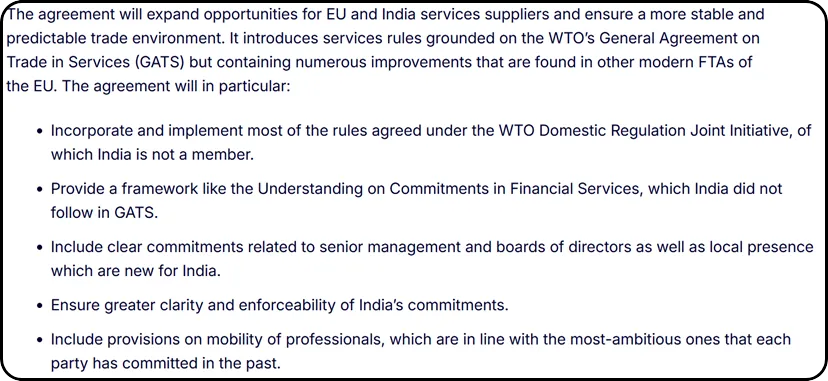
Now, apart from goods, there is a component that specifically addresses services trade.
According to the agreement, the EU will open 144 service subsectors to Indian service providers, and India will open 102 service subsectors to EU service providers.
Beyond the tariff reductions, trade deals include several additional provisions.
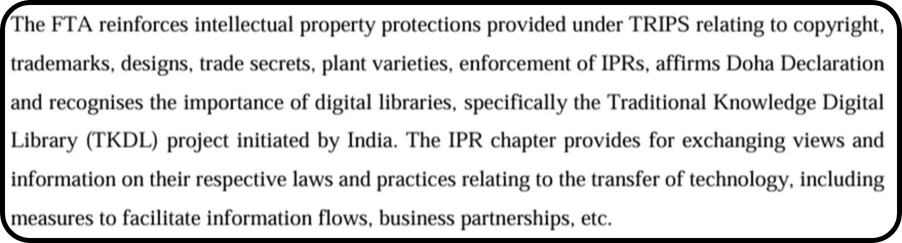
It includes a component of Intellectual Property Protection. This enforces rights and protection for copyright, trademarks, and confidential information.
The agreement also has a chapter dedicated to Small and Medium-Sized Enterprises (SMEs) and several other provisions that will benefit small companies.
Now, a critical point that’s often misunderstood:
Conclusion is not Implementation.
The approval process will take some time and is expected take 12 months or more.
Even after the deal takes effect, benefits don’t materialise instantly for all sectors as some take place in phases and the effects are seen gradually.
The India-EU “mother of all deals” concluded on January 27, 2026, and is a great case study to understand trade deals.
You now have the foundation to read about trade deal announcements, understand what was negotiated, and where it shows up in financial statements.
That’s the goal: Not to make you a trade policy expert, but to make you a better analyst.
Song of the Week
This is Parth Verma,
Signing Off.
Loved this simplification! Autmobile industry will be an interest watch in the next 2-3 years.
There never was an FTA finalised between India and the EU. Discussions yes, but no actual mutually-agreed text for an FTA.
Trade deals with India are always fraught over three main issues:-
The insistence in India for ‘home first’ - companies operating in India have to have primarily Indian ownership
Protectionism - linked to 1. Many industries in India are still effectively single company monopolies and competition is often prevented by the need for Government licensing
And as if those weren’t obstacles enough, we have the usual killer which is enhanced visa allocations - yes, you can have a deal provided you allow in hundreds of thousands of Indian migrants, not too many questions asked
India is not a profitable market for non-Indian companies at present. It will be in the future, but not right now - too many obstacles, too little immediate profit.
So, any FTA with India is a future play. Nothing wrong with that, but most countries will be looking to boost their immediate options in 2021/22.