

What Actually Made Diamonds Expensive?

Our aim through TVS Weekly is to break down financial stories and concepts simply, explaining what happened and why it matters to you.
No jargon, no drama, just stuff that actually makes sense!
Curious? Get more from us on our Instagram, WhatsApp, LinkedIn, or YouTube. Our 1 Million+ family awaits you!
In this week’s newsletter, we will be learning:
What actually made diamonds expensive, and why that price began to collapse.
Why lab-grown diamonds disrupted an industry that competition couldn't.
A mental model to separate genuine scarcity from manufactured scarcity in any market.
What Actually Made Diamonds Expensive?
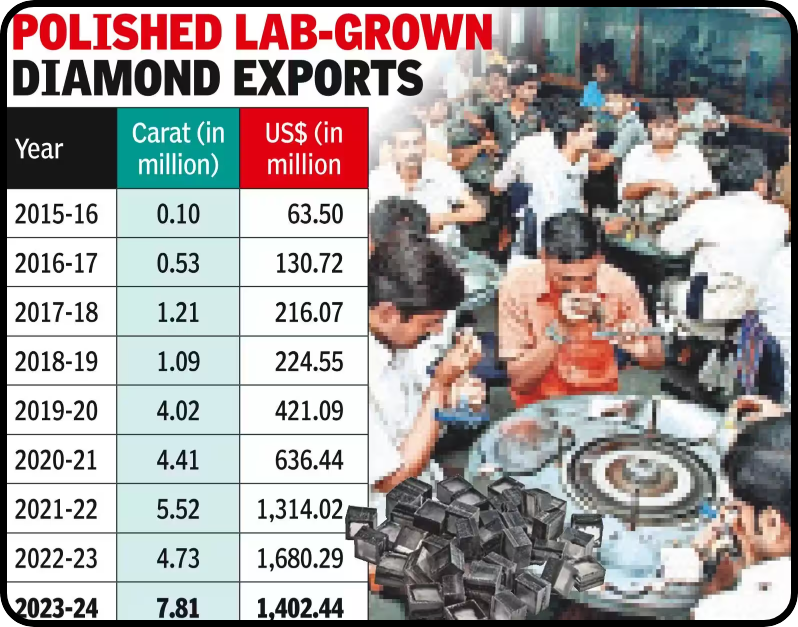
For the first time in its history, India has just exported more lab-grown diamonds than natural ones.
According to GJEPC trade data, polished lab-grown exports reached 18.8 million carats in FY2025-26, surpassing natural diamonds at 16 million carats.
Around the same time, De Beers, the company that once held 90% of the diamond market, agreed to be sold for close to $ 1 billion, a fraction of what it once commanded.
Here is the part that should bother you more than anything else.
A lab-grown diamond and a mined one are not different products pretending to be the same thing.
They are the same thing. Same carbon, same crystal structure, same fire, graded on the same scale by the same labs.
But one still costs up to five times as much as the other.
If they are identical, what exactly were you paying extra for?
Let us understand it all.
What Made a Diamond Expensive?
For most of the twentieth century, the answer had almost nothing to do with the diamond itself.
The Box
In 1888, Cecil Rhodes built De Beers by buying up the diamond mines of South Africa, one at a time, until there was almost nothing left to buy.
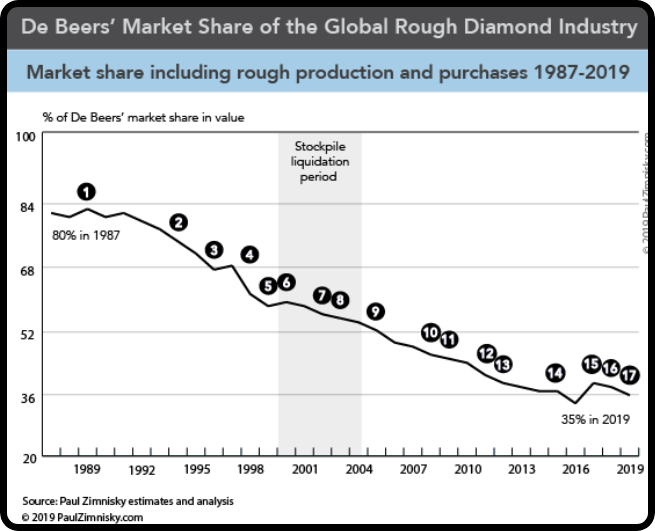
By the mid-1900s, the company controlled between 80 and 90% of the world’s diamond supply.
But they did not simply sell what they mined.
They decided how much of it the world was allowed to see.
And this is where they held a De Beers Sight system.
In this system, approved buyers, known as sightholders, were invited to view a sealed box of stones at a price De Beers had already fixed.
There was no room for negotiations, and you had to take the box or leave the business completely.
So the rarity was part real, but mostly it was arranged.
The Ring
Controlling the supply was only half the plan.
The harder problem was making people want a diamond in the first place.
Before the 1930s, a diamond engagement ring was unusual, not expected.
In 1947, a copywriter working on the De Beers account wrote four words that did more to the price of a rock than any mine ever could: “A Diamond Is Forever.”
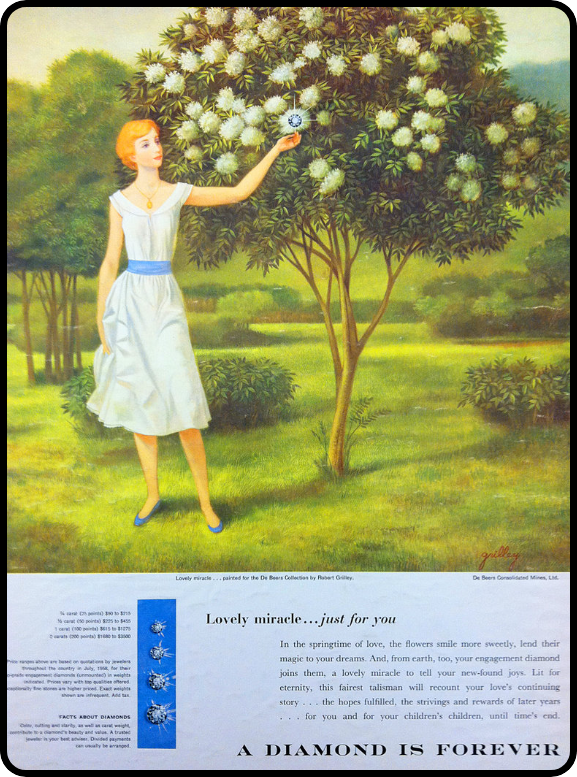
The campaign did not really sell diamonds. It sold the idea that love without one was somehow incomplete.
Within a few decades, the share of American brides receiving a diamond ring rose from around 10% to over 80%.
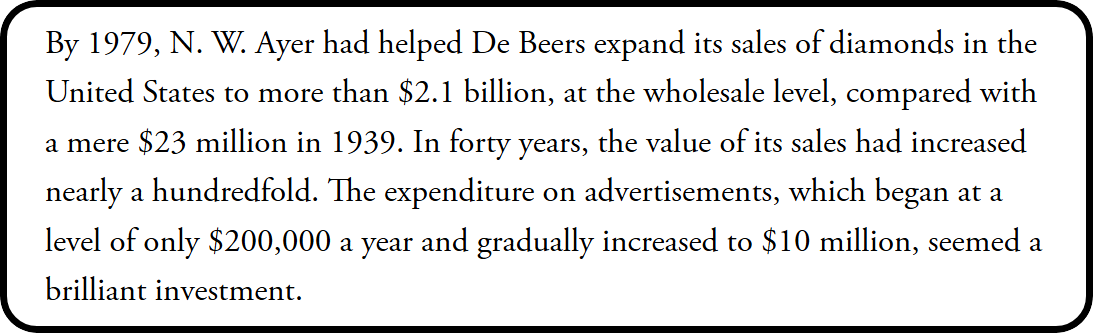
Even the popular belief that you should spend two months’ salary on a ring was a De Beers marketing line, not an old tradition.
The company also discouraged reselling diamonds, because a flood of second-hand stones would have revealed how little resale value they truly held.
So a diamond’s price stood on two legs.
How scarce it was kept, and how badly you were taught to want it.
Neither leg was the stone itself.
Then both legs broke
For decades, this arrangement held beautifully. Then, one at a time, both legs gave way.
The supply control broke first, and far earlier than most people realise.
Through the 1990s and 2000s, Russia’s Alrosa, Australia’s Argyle mine and new Canadian mines began selling their diamonds outside De Beers’ channel.
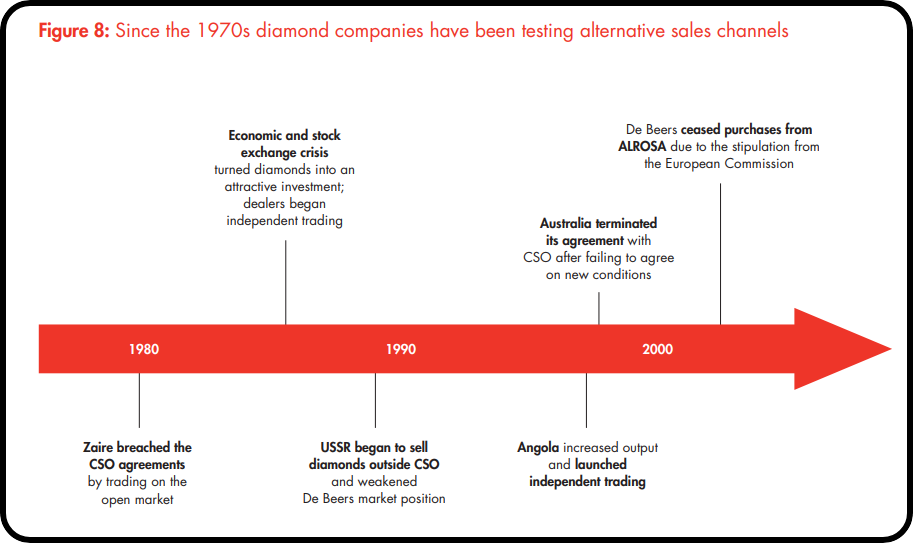
By the late 1990s, De Beers’ share of world diamond supply had fallen from around 90 percent to under 60 percent. By the 2000s, it was closer to 30 percent.
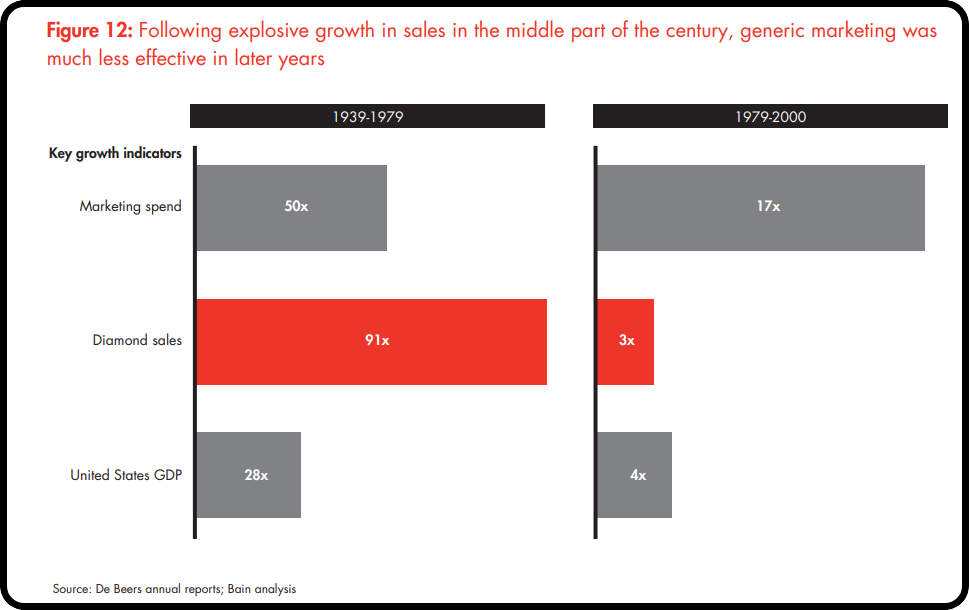
In 2000, De Beers admitted as much, shifting strategy toward independent brand marketing, an admission that it no longer controlled the market.
So the one lever everyone assumed was holding diamond prices up had genuinely broken, and prices barely moved.
If diamonds were expensive purely because supply was restricted, loosening that restriction should have brought prices down. It did not.
Something else was holding the price, and that something else was desire.
The company had lost the mines, but not what it had spent seventy years building inside people’s heads.
Then a lab did what an entire industry could not
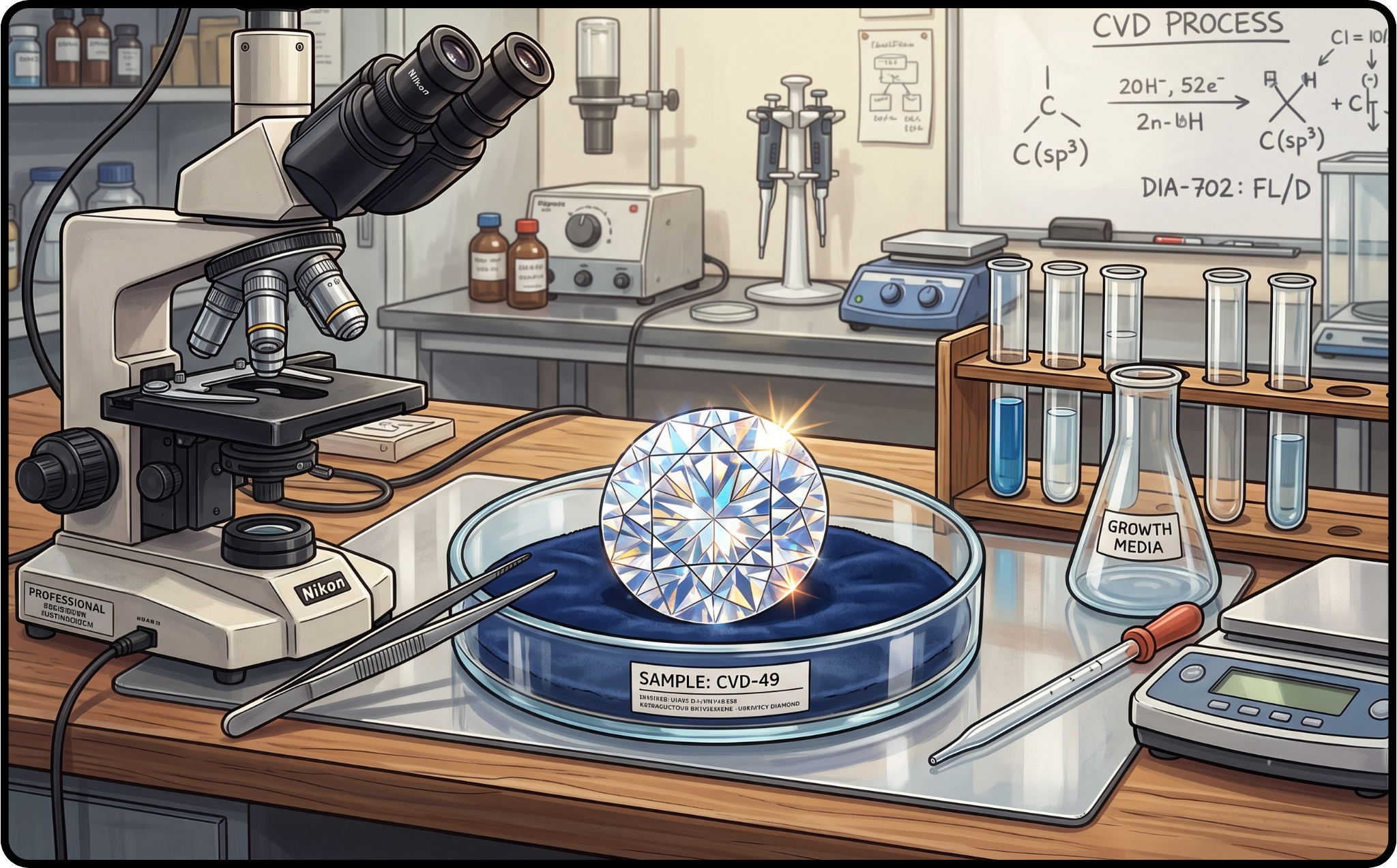
A lab-grown diamond is not a fake.
It is the same carbon, the same crystal structure, the same optical properties, graded on the same metrics by the same institutes.
The only real difference is that it forms in a few weeks instead of forming over a billion years.
A one-carat lab-grown diamond that cost over $3,400 in 2020 now sells for roughly $750 to $1,000.
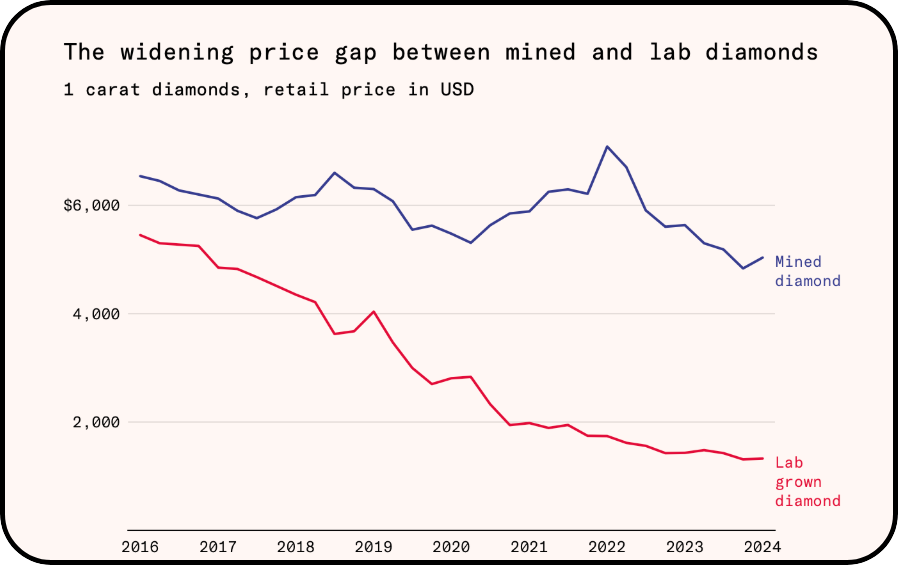
Lab-grown stones now cost 80 to 90% less than comparable natural ones, and made up more than 45% of US engagement rings in 2024, up from about 5% in 2019.
And the lab-grown diamonds did not gain market share by being better.
It won by being identical.
And once an identical stone can be made on demand, even the genuine scarcity of natural diamonds no longer matters to the price, because a buyer no longer needs a mined stone to get the same thing.
So Where Does India Stand In All of This
Surat cuts and polishes close to 90 percent of the world’s natural diamonds, built over generations by the same trading families.
Those same families are now running the machines, replacing them.
Surat’s own Lab-Grown Diamond Association says the city’s machines used to make lab-grown diamonds have roughly doubled in two to three years, from 4,000 to 5,000 to 8,000 to 10,000 today.
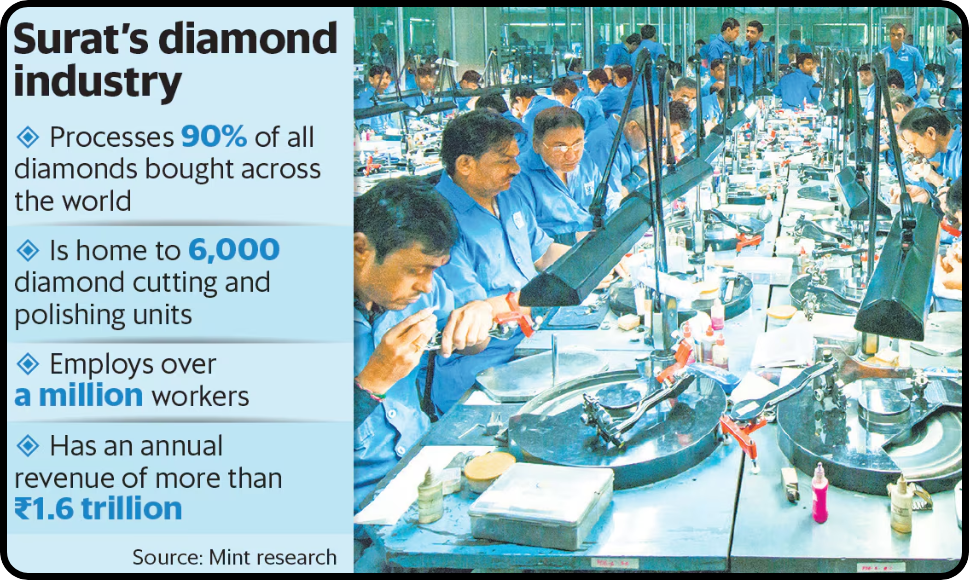
This is not an outside disruptor arriving in Surat. It is Surat’s own diamond trade, redirecting itself.
And, this is not a side story for India.
Gems and jewellery employ close to 5 million people and contribute about 7 percent of the country’s GDP.
But the diamonds and the gems and jewellery industry operate in different layers.
So Who Actually Gets Hurt
The pain from all this is not shared equally, and that unevenness is the real lesson sitting underneath the India story.
Miners like De Beers absorb the worst of it, because their entire business rested on controlling something that now has a close substitute and can now be grown in a lab.
Cutters and polishers of natural stones feel it next, through thinner orders and tighter margins.
Retailers, further down the chain, have more room to move and Titan shows this clearly.
Its Tanishq brand still sells the language of natural rarity, backed by a marketing partnership with De Beers itself.
In December 2025, Titan also launched beYon, an entirely separate brand built around lab-grown diamonds.
And all of this does not mean that natural diamonds have disappeared.
By value, they still make up most of India’s diamond exports, since lab-grown stones cost far less per carat even at higher volumes.
And natural diamonds losing their market share to lab-grown diamonds has nothing to do with their shine.
The diamond itself is exactly what it always was, carbon compressed for a billion years, unchanged by anything happening in the market around it.
What broke was never the diamond.
It was the arrangement built around it, supply kept tight, and desire kept high, for as long as neither could be copied.
Notice what did not break in the same years.
Gold kept climbing to record highs through the very period diamonds fell, because gold’s scarcity is real and hard to replicate, and the world’s appetite for it is old enough that no single advertising campaign invented it.
Diamonds only looked that way for a while.
So here is something worth carrying with you, the next time anything is sold to you as rare, limited, or timeless.
Is it actually scarce? Or has someone simply made sure it feels that way, for exactly as long as they could keep the box closed.
Song of the Week
This is Parth Verma,
Signing Off.
This article is so practical even myself now thinking to buy lab grown diamond bcs of lower price😭