

India’s Data Centre Boom

Our aim through TVS Weekly is to break down financial stories and concepts simply, explaining what happened and why it matters to you.
No jargon, no drama, just stuff that actually makes sense!
Curious? Get more from us on our Instagram, WhatsApp, LinkedIn, or YouTube. Our 1 Million+ family awaits you!
In this week’s newsletter, we will be learning:
The business, the money, and the risks behind India’s data centre surge.
My advice on creating your first financial model.
What is Risk Premium.
Market Kya Keh Raha Hai Sir?
In 2025, the headlines have been dominated by massive numbers in the data centre space.
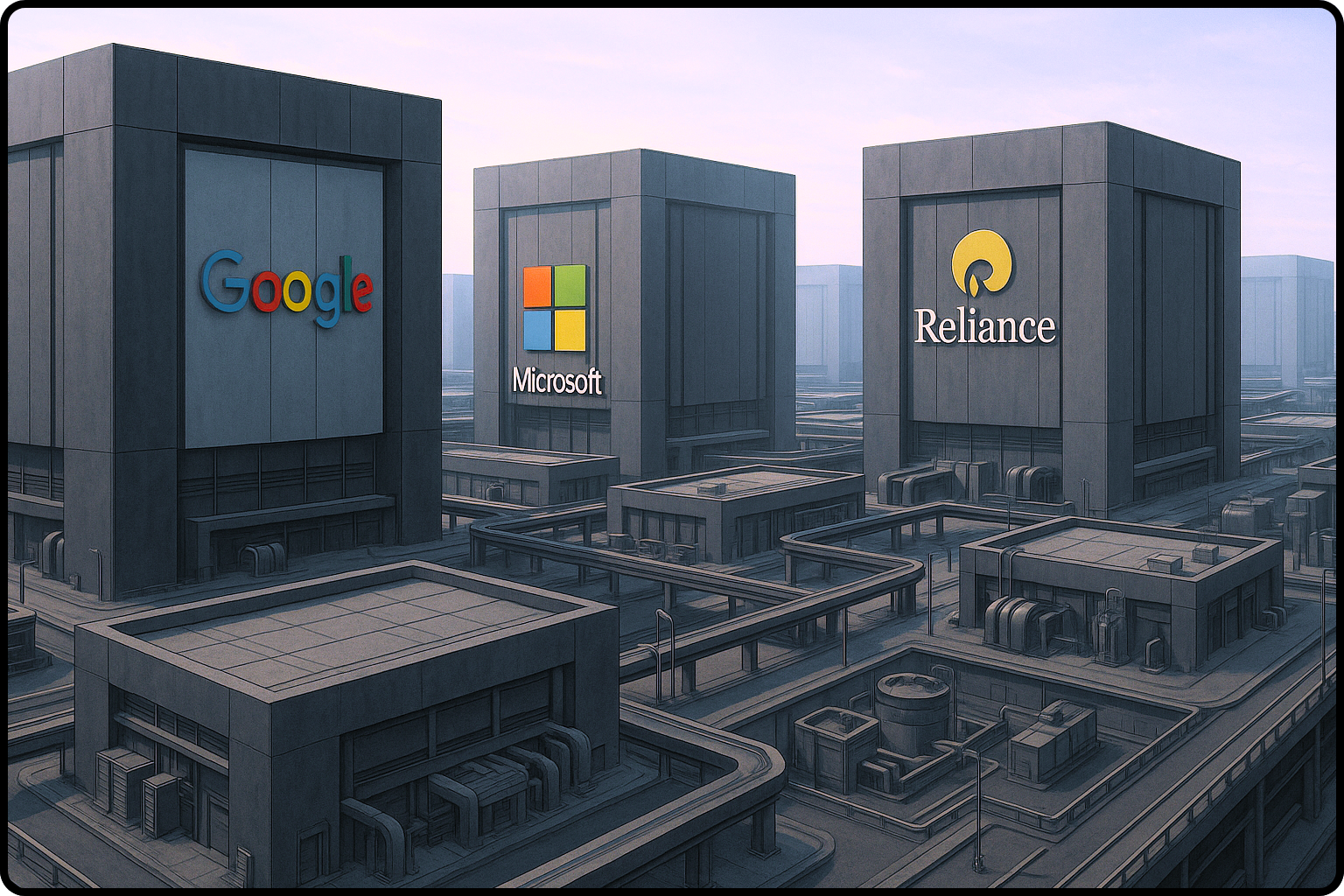
Microsoft announced a $17.5 billion investment in India. Google committed $15 billion. Reliance Industries outlined plans for $12-15 billion.
That’s already over $45 billion from just three players, and if you add the others, we are heading towards a big investment.
This level of spending raises critical questions about why everyone is spending so much and how they will make money from this.
This newsletter answers your questions as we cover what’s being built, how the money flows and what might break the entire story.
The Infrastructure Story
AI has grown rapidly over the past few years, and data centres have become an integral part of that growth.
With billions flowing into AI infrastructure, it becomes more important to understand the what and why behind it.
What’s actually being built
Let’s start with what a data centre actually is.
It’s basically a large building full of computers that work together to run things like AI models, cloud services, and digital applications.
When you use an AI model like ChatGPT, you are not just running it on your laptop, as it involves thousands of computers working together in a data centre to deliver your result.
Right now, India has around 1.2-1.5GW of data centre capacity, which is estimated to increase around 3-5x by 2030.
And building this requires huge costs, which justifies the large investments being made.
Apart from this, data centres also need electricity.
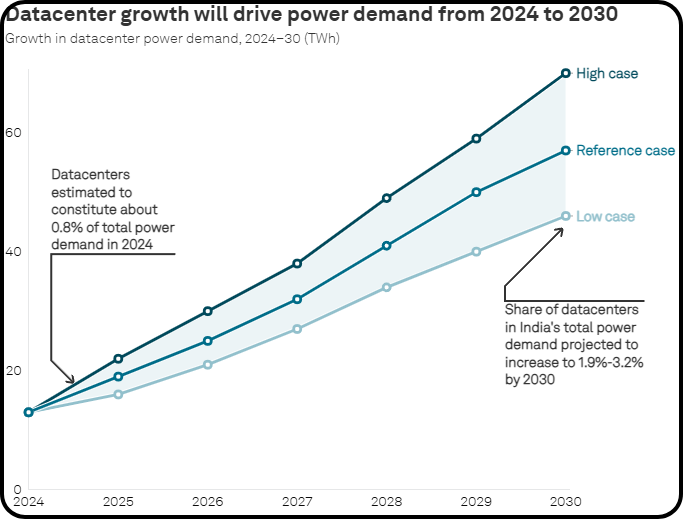
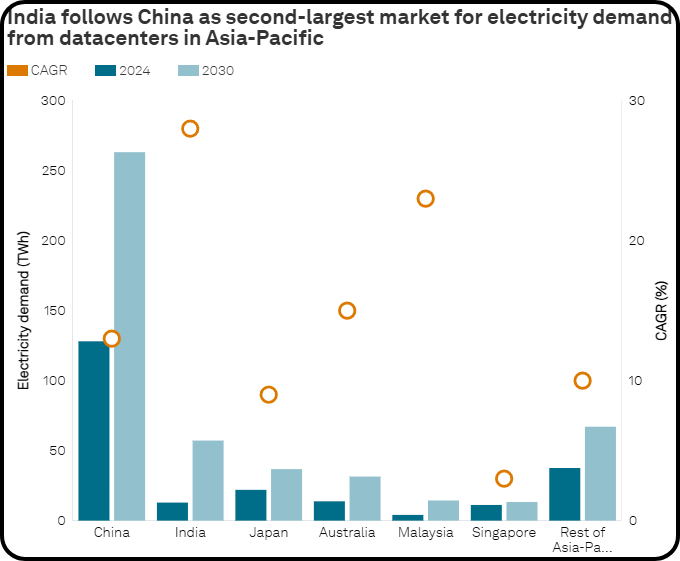
In 2024, their consumption was about 13 TWH per year, which is expected to increase to 57 TWH by 2030.
So as data centre demand grows, electricity demand grows alongside it, which is a classic example of derived demand.
But,
Why is this Happening Now
As of 2024, India had over 800 million internet users, which is massive for companies selling cloud services and AI models.
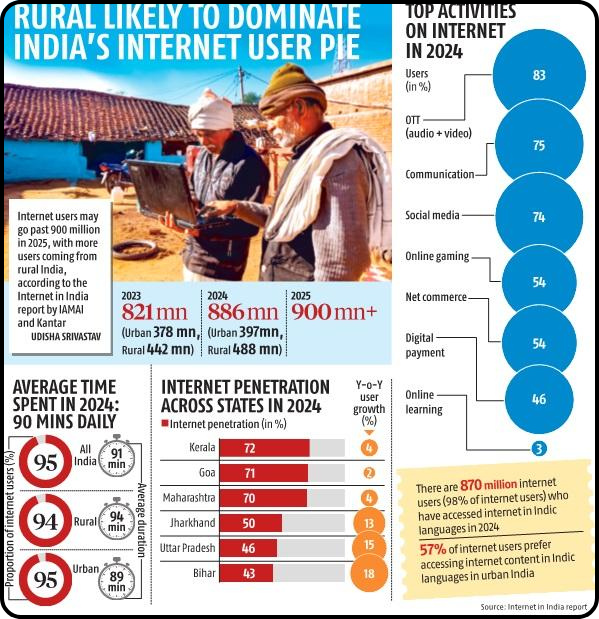
And to reach such a large audience, they need servers in India to provide their services efficiently.
Apart from this, there is the Digital Personal Data Protection Act (2023) that sets strict rules about how companies handle personal data.
While the DPDP Act doesn’t impose a localisation ban, when you combine it with RBI and sector-specific rules, it’s simply safer for banks, insurers, and government bodies to keep sensitive data on local servers.
Moreover, a draft National Data Centre Policy and various state policies add tax breaks, GST credits, cheaper land and power to attract data centre builds.
And the PLI scheme aims to localise more of the data centre hardware stack in India.
How Do They Make Money?
Now, as we have read about AI infrastructure and some of the key factors behind its demand, it also becomes necessary to understand how these investments will pay off.
And there are different ways in which a data centre can generate profits depending on who owns it.
Let’s first take the example of companies like Google and Microsoft.
These companies build data centres and also use them as a means to sell cloud and AI services.
Their ROI comes from the steady stream of revenues paid by millions of customers (businesses, developers, government, consumers) who use their cloud platforms like Azure, Google Cloud.
The data centre is just the infrastructure that makes the service possible and the real money comes from the services which they provide through it.
Now, if we take the example of some local players, they are doing something different
They build data centres and lease the capacity to companies.
Simply put, instead of providing AI and cloud services, they are providing the data centre infrastructure as a service to large enterprises.
With respect to Reliance, Morgan Stanley estimates they can charge roughly $1.5 to 1.6 million per megawatt of capacity per year.
For example, if they build a 300-megawatt facility and it’s full, they get $450 million in annual rent.
If this happens, they can earn stable, predictable returns, just like a landlord collects rent.
But alongside the opportunity, there are hard questions that can’t be ignored.
What If Things Go South?
Yes, as we are heading towards building large data centre capacities, there are things which require attention and cannot be overlooked.
The Critical Risks
Remember, we mentioned that the power demand for data centres is expected to jump to 57 TWH by 2030.
But can India’s power grid actually expand that fast, as building new power plants takes time.
Analysts have warned that renewable energy capacity specifically needs to scale rapidly.
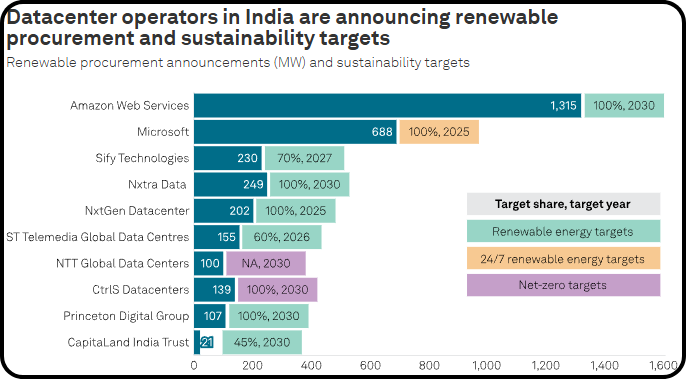
And if the power demand is not met, data centres might remain underutilised, which will mean billions spent without any revenue.
Furthermore, a lot of companies are building data centres at the same time and targeting 2027-2030 for completion.
If all succeeds and the demand falls, it will lead to overcapacity and lease rates can drop.
For example, the rates can fall from $1.5 million per MW to $1.2 million. That sounds small, but it can compress profits significantly.
Interestingly, Norway’s Sovereign Wealth Fund has specifically warned about “data centre sector volatility” for this reason.
And there is a policy risk too, which prevails, as any new change in the policy in future can restrict or change certain rules.
The Future Story
Right now, we are in the construction and investment phase, where it is too early to judge.
And if things go well, India is expected to have a data centre capacity of about 9 GW by 2032.
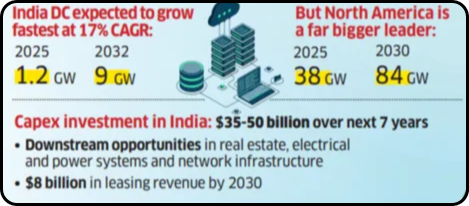
Analysts also expect that India can become the second largest market for data centre electricity demand in Asia-Pacific over the next two years, surpassing Japan and Australia.
The companies involved in this are also expected to grow, with Reliance’s new infrastructure business estimated to be worth $30 billion by 2027.
For investors and analysts, the valuation story of India’s AI infrastructure is just beginning.
We are likely to see new business models, spin-offs, and possibly listings of data centre trusts or AI ventures in the coming years.
We will get more clarity about all this by 2027-2028, when the facilities start to come online and see if the demand projections were correct.
Until then, we are watching the early chapters of a long-term story that can define India’s digital economy.
So, do you think this boom will live up to the expectations?
Kaam Ki Baat!

“Sir, how should I approach building my first financial model?”
Here’s what I told them:
Most students fear modelling because they think it’s a test of accuracy.
While your first model is simply a way to understand how a business becomes numbers.
Here’s a simple way to start:
Start with the business, not the model.
Ask simple questions: What does the company sell? What drives its revenue? What drives its costs? If the business logic is clear, the model becomes far easier.Rebuild history before forecasting the future.
Take the last 3–5 years of financials and try to rebuild them. This teaches you how the statements connectFocus on structure, not complexity.
A simple model with clean links tells a better story than a complicated sheet filled with formulas you don’t understand.Improve it layer by layer.
Your first version is just a draft. Your next version will add depth. And with every company you model, your judgment becomes sharper.
So start small.
Even understanding what a company earns, spends, and keeps is enough to begin.
If you can make sense of those three ideas, you’ve already taken the first step toward building a model; the rest comes with practice.
Dalal Street Dictionary
Imagine you’re forming a group for a project. One teammate always submits on time, while another often finishes at the last minute. If both offer to handle an important section, you’d expect a little extra assurance from the second person because the uncertainty is higher.
That “extra” expectation is similar to a Risk Premium.
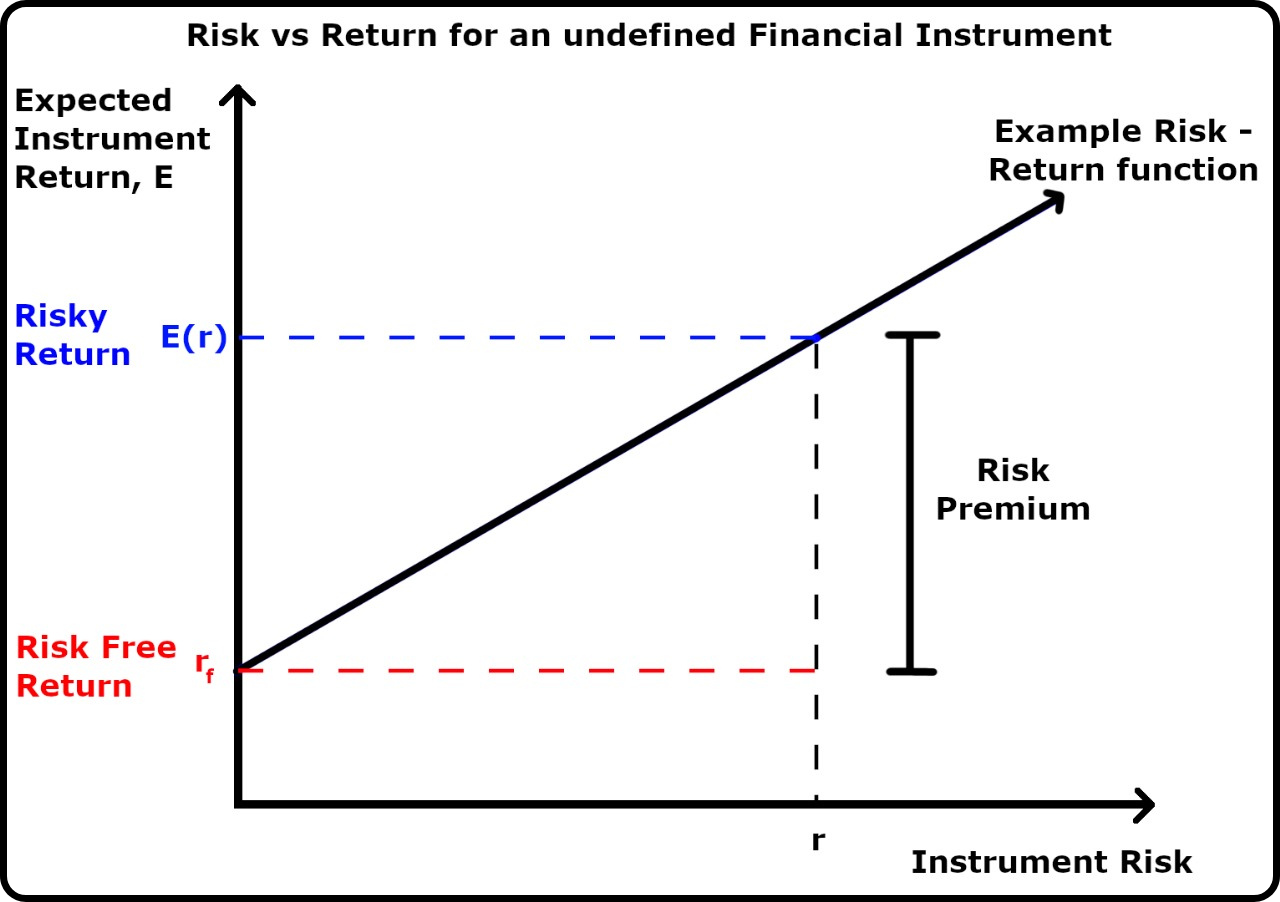
In finance, safer assets like government bonds generally offer lower returns because the level of risk is relatively low. Assets with higher uncertainty, such as corporate bonds or equities, typically offer higher expected returns to compensate for that additional risk.
The difference between the return on a risky asset and a safer one is what we call the Risk Premium.
How to Spot It:
Compare returns between two assets with different levels of risk (for example, government bonds vs. corporate bonds).
Look at credit ratings: lower-rated issuers usually offer higher returns.
Why It Matters:
It helps explain why different assets offer different expected returns.
It forms the basis of many valuation and portfolio models, including how expected returns are estimated.
It helps students understand the relationship between risk and return in a structured, measurable way.
In short, the Risk Premium represents the additional return an investor expects for accepting greater uncertainty than a safer alternative.
MEME OF THE WEEK

What Else Caught My Eye?
Amazon’s new $35 billion India push.
Uber has launched Uber Direct.
Railways open up for big QSR chains.
Paramount & Netflix fight for Warner.
Recommendations
“I had the whole wrong idea for eight years.”
That’s Warren Buffett admitting he wasted nearly a decade chasing stock charts before discovering the truth at 19 when he read The Intelligent Investor and realised he’d been thinking about it all wrong.
This 11-minute video captures his breakthrough: stop picking stocks, start owning businesses. Buffett explains why he’s indifferent to daily price swings, why he actually hopes markets fall when buying, and why the right mindset beats genius-level IQ.
Song of the Week
This is Parth Verma,
Signing Off.
I have 2 Questions related to this article
1)Will this data centers going to create jobs in India or will leads to the unemployment ?
2) What about water which is most important while cooling the Data centres, we already seen the water shortage in cities like Bengaluru ?
Nuclear power will be next power source to fulfill the energy requirement by the data centers. If anything you can bring on nuclear energy, that would be great.