

How Big Deals Happen


Our aim through TVS Weekly is to break down financial stories and concepts simply, explaining what happened and why it matters to you.
No jargon, no drama, just stuff that actually makes sense!
Curious? Get more from us on our Instagram, WhatsApp, LinkedIn, or YouTube. Our 1 Million+ family awaits you!
In this week’s newsletter, we will be learning:
How an M&A deal gets structurred
My advice on building a portfolio of your projects.
What is Deleveraging Cycle.
Market Kya Keh Raha Hai Sir?
2025 gave us a great deal of news in the Mergers & Acquisitions space.
After 20 years, Indian banks are now allowed to finance M&A deals.
Global players are coming to India and acquiring stakes in domestic companies.
And while we talk about global, recently Netflix announced one of the largest media acquisitions in history with an $82.7 billion deal to acquire Warner Bros. Studios.
This deal sounds huge, but how did we get here? And where does the deal go from here?
These questions get answered when you understand how M&A deal structuring works, and that’s exactly what we will explore in this newsletter.
But before that,
Mergers & Acquisitions 2025 Wrapped
You must have checked your Spotify Wrapped by now and discovered your favourite song.
Let us now see how the year is for Mergers & Acquisitions.
India recorded $26 billion in deal value across 649 transactions in the first nine months.
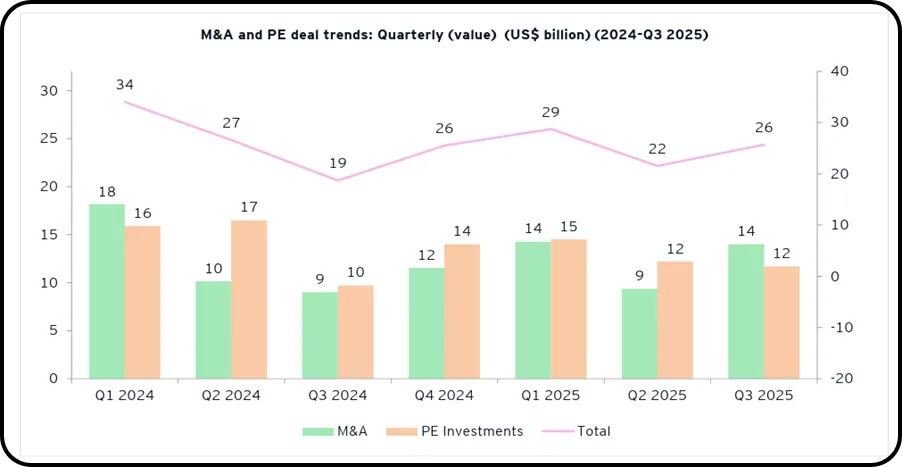
With notable deals such as Emirates NBD’s $3 billion acquisition of RBL Bank (the largest foreign investment in Indian financial services).
Another deal which made a lot of buzz was Japan’s Sumitomo Mitsui Banking Corporation acquiring nearly 25% stake in Yes Bank.
Moreover, one big change was regulatory, where Indian banks are now allowed to finance M&A transactions, and analysts expect this to unlock a ₹5 lakh crore opportunity for the banks.
On the global front, we saw the announcement of Netflix acquiring Warner Bros. Studio to make one of the biggest media acquisitions in history.
And just after three days, Paramount Skydance launched a counterbid worth $108.4 billion, which is even bigger.
Moments like this show why M&A is not a straight line, but a moving process that can change overnight.
And this is where a solid understanding of deal structuring separates headlines from real insight.
Understanding the MA Deal Cycle
MA deal structuring works in broadly 10 different stages.
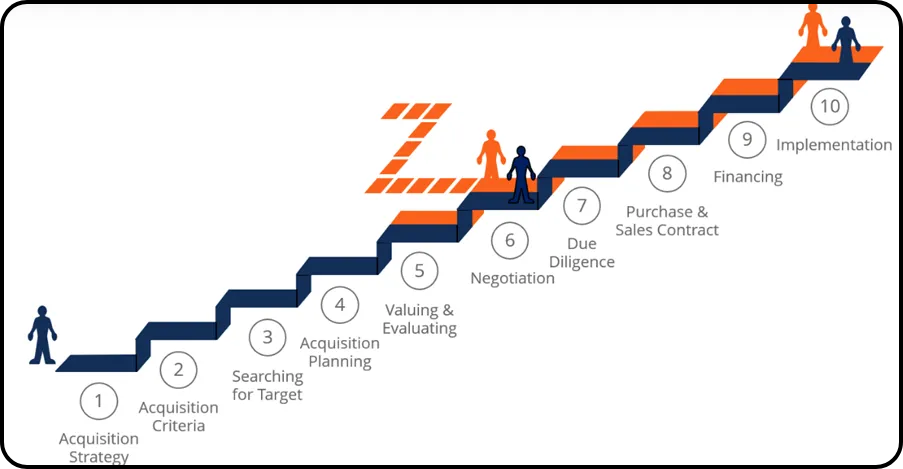
Not every organisation will follow the sequence; some might do due diligence before conducting valuations, but the broader theme remains the same.
Starting Off
Every M&A deal begins with clarity.
The investment bank meets with the client (the acquirer) to understand exactly what they want to achieve.
The more objective and specific this strategy is, the better the execution.
Generally, the internal strategies are confidential, but in the case of Netflix, we had a public announcement from their CEO.

And once the idea and purpose are clearly defined, we move to the acquisition criteria.
So during the acquisition strategy process, the acquirer also specifies the acquisition criteria.
Think of it as a checklist of things that need to be passed when searching for a target company.
It can include factors like:
Geography - The target company needs to be in a specific region or area
Margins - There can be criteria of certain margin requirements, like ROCE, ROE
And this is purely subjective and can change from company to company as per their needs.
Then, based on the acquisition criteria, the investment bank identifies potential targets that match their requirements.
This can be done through internet search, investor meets, and angel meets.
In the case of Warner Bros., multiple bidders identified it as an attractive target and placed their bids.
The companies were:
Netflix
Paramount Skydance
Comcast (later withdrew)
And once the target is identified, the investment bank meets the target, and things move ahead.
Moving Ahead
Now we come to the acquisition planning stage, where the target’s business model, operations and openness to the deal are assessed.
It is basically done to understand the target deeply before moving ahead with the deal structuring stages.
And to check whether any critical issues are there or something which might not match the criteria.
Once all the information is gathered, we move to the valuation stage.
In this stage, the investment bank uses information from the previous stage and builds a financial model to determine what the target company is worth.
It can be done through different methods, like:
Discounted Cash Flow Method
Multiple Approach
Transaction Analysis
For example, Netflix came up valuing Warner Bros. at $72 billion in equity value and $82 billion in enterprise value, which also includes debt.
And their CFO estimates that this acquisition can generate them $2–3 billion in annual cost savings within three years of deal closing.
Once the valuation is finalised, the acquirer makes an offer to the target company and then starts the negotiation process.
It’s just how you negotiate with your sabziwala; companies negotiate between them, but for billions.
Generally, the offer should be reasonable, high enough to be attractive and not too high.
You might think that no one will decline a higher offer, but it happens, and it actually did while I was writing this newsletter.

The acceptance of the offer is in the hands of the target company, and they can accept the offer which they find suitable and not the one that provides the highest value.
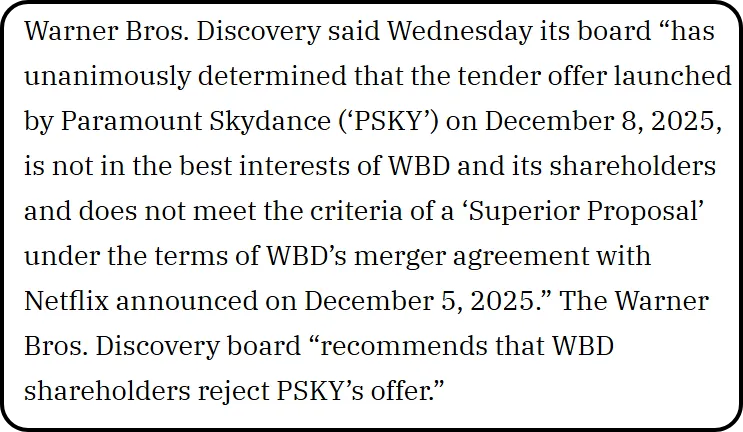
And once the offer is accepted, the next step is Due Diligence.
Due diligence is the process of verifying a company’s numbers, risks, and reality before finalising how a deal is structured.
Suppose a company has ₹10,000 crore revenue but hides a ₹50,000 crore legal liability; this can cause a major risk to the acquirer, and they should know about this before finalising the deal.
After the due diligence is done and all the provided information is verified, we move ahead with the execution process.
Finalising The Deal
Once the due diligence is positive, we move ahead with executing the contract.
In this stage, the legal team of the Investment Bank plays a major role and builds a contract.
An MA contract includes almost every minute detail, from conditions, fees, approvals, and restrictions.
For example, there is a 2.8 billion clause in the merger agreement of Netflix and Warner Bros. Discovery, where WBD will have to pay this amount to Netflix if they reject their proposal or accept any other offer.
And after the contract is finalised and the terms are agreed, the acquirer works on a financing strategy.
In this, the investment bank works with the top management of the company and explores options to finance the deal.
Sometimes the financing strategy is already prepared, but the details come after the contract is signed.
Netflix is financing their deal with part cash and part equity, where it has taken a $59 billion bridge loan.
Simply, a bridge loan is temporary funding used to complete an acquisition immediately, before arranging permanent financing like bonds, equity, or long-term loans.
And Netflix’s $59B ranks as the second-largest bridge loan ever and the largest for an investment borrowing.
After the financing takes place and the deal is closed, there are certain regulatory approvals required.
In the Indian context, the first intimation should go to the Exchange and SEBI.
Following this, approval is required from the Competition Commission of India, which prevents anti-competitive practices and protects consumers.
An approval from the National Company Law Tribunal is required, which ensures the merger scheme is fair and legal.
And once all regulatory approvals are completed, the deal stands officially closed, and a public announcement is made.
In conclusion, whether it’s Netflix acquiring Warner Bros. for $82.7 billion or Emirates NBD acquiring a stake in RBL Bank for $3 billion in India’s largest banking acquisition, the M&A deal structuring largely remains the same. For finance students aspiring to work in investment banking or evaluate M&A as investors, understanding how deal structuring works and developing skills in this area becomes crucial.
So, what part of an M&A deal do you find the most interesting?
Kaam Ki Baat!

“Sir, how do I build a portfolio of projects that recruiters actually care about?”
Here’s what I told them:
Most recruiters don’t look for a long list of projects.
They care about whether you understand what you’ve done.
A strong project is straightforward. It shows that you can select a genuine problem, work through it carefully, and explain your thinking.
Here’s how to do that:
Work on real companies.
Use actual annual reports and real numbers. This alone makes your work more meaningful than most projects.Explain your thinking in simple words.
Don’t hide behind formulas. Be clear about why you made certain assumptions and what you learned.Show what you would do differently next time.
Mention what confused you, what didn’t work, and what you would improve. This shows maturity.Be able to talk through your work comfortably.
If you can explain your project calmly, you’ve built something recruiters respect.
Recruiters hire individuals who can think critically and learn effectively.
So ask yourself:
If someone reads my work, will they understand the reasoning behind my decisions?
If yes, your project is doing its job.
Dalal Street Dictionary
Imagine you’ve been using your credit card a lot. At some point, you realise the monthly bills are getting uncomfortable. So instead of spending more, you decide to cut expenses and start paying off your dues. For a while, you buy less, save more, and focus on reducing debt.
That phase is called deleveraging.
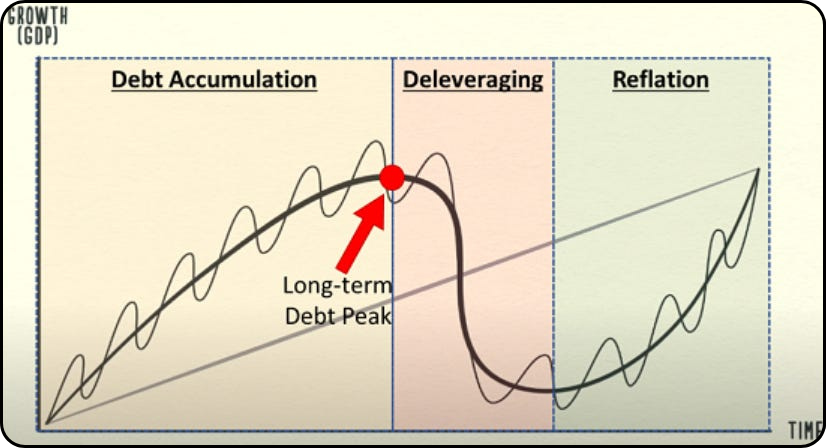
In finance, a deleveraging cycle occurs when companies, households, or governments shift their priority from growth to debt reduction. Instead of taking new loans to expand, they repay existing borrowings, strengthen balance sheets, and reduce risk.
You can spot a deleveraging cycle when companies focus more on repaying existing debt than on borrowing to expand.
Another sign is slower growth in new loans, as businesses and banks become more cautious about adding debt.
Understanding a deleveraging cycle helps explain periods when economic activity slows because companies and lenders are focused on reducing existing debt rather than expanding borrowing. During such phases, balance sheet repair takes priority over growth, which can affect the pace of investment and lending.
In simple terms, a Deleveraging Cycle is the economy choosing stability before speed.
MEME OF THE WEEK

What Else Caught My Eye?
Bhavish Agarwal sells Ola Electric shares.
Debt-to-GDP will be the government’s core focus in FY26.
NCLT approves Vedanta’s split.
HDFC Group receives RBI approval to hold a 9.5% stake in IndusInd Bank.
Adani Group plans expansion in Indian airports.
Recommendations
Do you think confidence is something you’re born with? Dr. Ivan Joseph, a former athletic director and head coach, disagrees. He argues that self-confidence is a skill that can be learned, like financial modeling.
In this 13-minute TEDx talk, he breaks down the exact mechanics: repetition, persistence, self-talk, and how to interpret feedback in your favor. If you’ve felt underconfident recently or maybe during internships or exams, this is the reset you need.
Song of the Week
This is Parth Verma,
Signing Off.
Thank You for sharing sir a very detailed information about M&A
-->I have 2 Questions
1) How will M&A help to Indian banks?
2) Is it necessary that M&A Will always create synergy?
What the project case reported , it's far more valuable.
Actually working, making impression.
It's really good like wow ....